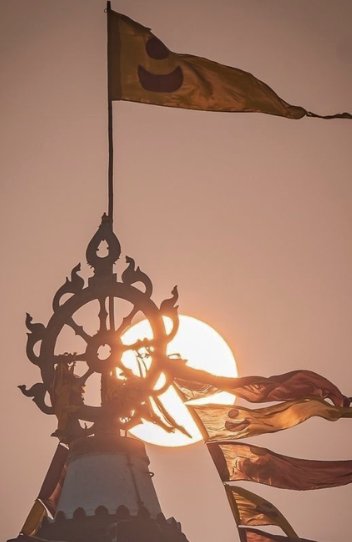
The Jagannath Temple in Puri, Odisha is one of the most revered temples in Vedic culture. Over the centuries it has accumulated many stories, mysteries and legends that imply phenomena which seem to defy common understanding of science. Here are some of the most famous ones:
● The main spire called the shikhara of the temple never casts a shadow on the ground, at any time of day. This is very unusual, since under normal physics almost any object in sunlight will cast a shadow, except in special architectural setups or particular solar positions. There are plausible architectural or geographic explanations (orientation, shape, overhangs, alignment with compass directions etc) which are yet to be discovered.
● The temple's flag always flies in the direction opposite to the wind. This contradicts basic aerodynamics as wind direction should determine how a flag flies (though turbulence, eddies and local obstacles can redirect winds locally). Scientific explanations point out that structural features near the flag post (tower shape, wind deflection off walls, topography) may lead to local wind behaviour being odd, causing what appears to be 'opposite' fluttering. However, no scientific study published in peer reviewed literature conclusively shows a persistent contradiction to wind physics here.
● As one enters through the Singha Dwara (Lion Gate) of the temple, even though nearby is the sea with its roar, the sound of the ocean is no longer heard (or at least greatly diminished). This is an engineering marvel with well-designed courtyards, thick barriers, and particular layouts to dampen external sound, especially low frequency noise. The temple is also built with massive stone walls and enclosures that may reflect or absorb sound, producing what seems to be silence.
● In the temple kitchen (rasoi or rsoasala), seven earthen pots are stacked one above another over woodfires. According to legend, the topmost pot cooks first, even though heat should be more intense lower down, nearer the fire. This seems most obviously contrary to thermodynamics and heat transfer. Possible explanations include airflow, draft, chimney effect, possibly how the fire is built, radiant heat or design of hearths that leads to heat rising more efficiently to the top pot, but none has been convincingly explained till now.
● More interestingly, the Sudarshan Chakra mounted at the top of the temple is said to appear to face the observer from wherever you stand in Puri.
● Surprisingly, temple has no flies or birds flying directly above it.
● The mahaprasad (the sacred food) which is made here never spoils and is always precisely enough for the devotees, never wasted.
● Also, the temple lacks a foundation in the usual sense, yet has survived earthquakes, storms and weather for centuries.
Jagannath Temple showcases a series of remarkable phenomena, some of which appear to defy everyday expectations.
From a scientific standpoint, the temple is as an engineering marvel, blending spirituality, environmental awareness and structural ingenuity. Its layout, orientation, materials and acoustic properties suggest a deep knowledge of the physical world and the advanced knowledge of our ancient seers.
What appears mysterious may well be the product of deliberate design, intended to inspire and convey a deeper harmony between nature, human craftsmanship and advanced Vedic knowledge.