
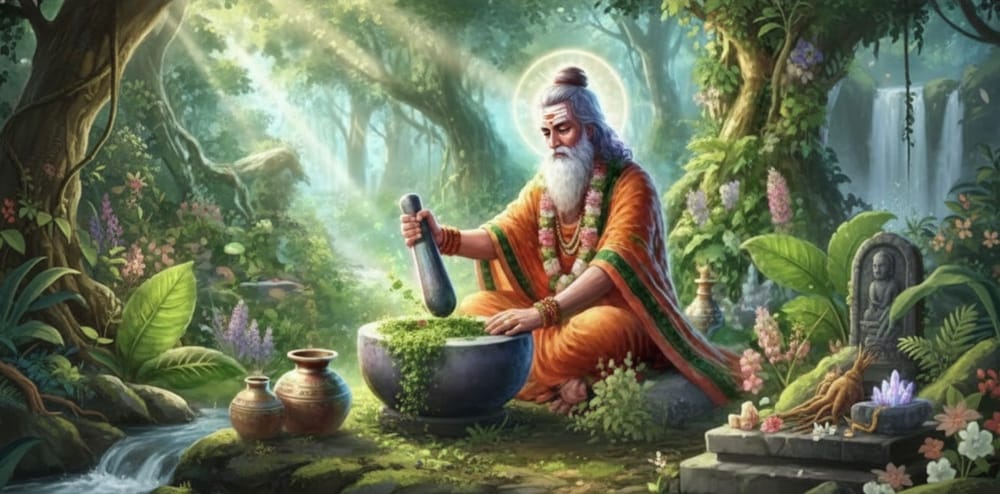
Rishi Chyavan rises from the Vedic and puranic texts as a powerful exemplar of austerity, insight and immortality. He was the son of Rishi Bhrigu and Puloma, known for his immense penance and for rediscovering the secret of rasayan—the science of rejuvenation. He was aged and weak after long meditation but through divine herbs and his yogic power, he regained youth, this became the basis for chyawanprash, the Ayurvedic elixir named after him.
Rishi Chyavan's siddhis (spiritual powers) began with his intense tapasya and renunciation. Long continued austerities granted him powers beyond the ordinary: vision into other lokas (realms of existence), mastery over his senses and the ability to transcend the limitations of age and form. Following siddhis are attributed to Rishi Chyavan, based on Vedic and puranic sources:
1.Tapas-shakti (Power of Austerity) – Mastery gained through intense penance and meditation, allowing control over body, mind and environment.
2. Divya-drishti (Divine Vision) – Ability to perceive other realms (lokas) and see beyond ordinary sensory limits.
3. Ajar-Amaratva (Reversal of Age / Immortality) – Ability to reverse ageing and restore vitality symbolized in his own rejuvenation. This symbolises victory of spiritual energy over decay and time. He used herbs, mantras and inner prana mastery to renew his body—this became the origin of Kaya Kalpa Chikitsa in Ayurveda.
4. Mano-siddhi Control of Mind and Senses) – Perfect restraint and direction of thought and sensory energy.
5. Aushadhi-jnana (Knowledge of Healing Herbs) – He had profound understanding of medicinal plants, forming the basis for chyawanprash.
6.Pran-shakti (Mastery over Vital Energy) – Ability to channel and preserve life force for longevity and strength.
7. Bhuta-jaya (Dominion over Elements and Beings) – Power to command elemental and divine forces, exemplified in creating the demon Mada.
8. Dharm-buddhi (Cosmic Insight and Moral Vision) – Wisdom to discern and uphold cosmic law, as shown in defending the Ashvins' right to Somaras.
- Anugreh-shakti (Blessing and Healing Power) – Ability to transmit vitality and blessing to others, turning his personal siddhi into a collective boon.
10. Jnana-siddhi (Realization of the Self) – Ultimate gyan marking liberation and enlightenment.
In the epics, Rishi Chyavan is described as being powerful enough to oppose the thunderbolt (vajra) of Devraj Indra and to create the demon Mada in order to secure the rights of the twin physician-gods Ashvins to partake in the sacrificial offerings. This signifies not only spiritual might but deep moral and cosmic insight. Rishi Chyavan perceived that the Ashvins had been denied their rightful share, so he used his powers to restore the order of dharma.
Rishi Chyavan also created the demon Mada, symbolising intoxication, to subdue Devraj Indra. Realising his error, Devraj Indra apologized and granted the Ashvins their share of Somaras. Rishi Chyavan then dispersed Mada into four lesser indulgences which are gambling, lust, wine and hunting, representing ways in which sensory energy is wasted through lower pleasures.
Thus, his siddhis are aligned with cosmic justice and the maintenance of spiritual law. Once Rishi Chyavan performed deep meditation in the forest near the Saraswati River. He entered such a long and still samadhi that ants built an anthill around him and only his eyes were visible.
His body had aged and weakened from years of austerity—but his inner light was blazing. One day, King Sharyati, son of Vaivasvata Manu, was camping nearby with his beautiful daughter Sukanya. As she wandered, she saw two bright, glimmering spots on an anthill — the eyes of the meditating sage—out of curiosity, she poked them with a thorn.
Instantly, Rishi Chyavan awoke and his penance was disturbed. The energy of tapas reversed into the king's camp—all men became constipated and their bodies heavy. Realising her mistake, Sukanya confessed to her father, who came to the sage and begged forgiveness.
To restore harmony, the sage asked for Sukanya's hand in marriage, and the king agreed. Sukanya faithfully served her aged husband, even though he was frail and wrinkled. His young bride Sukanya displayed such an unshakeable fidelity and devotion towards her husband that Ashwins decide to rejuvenate Rishi Chyavan.
After ritual immersion and application of herbal treatments and his tapas shakti, he emerged young, strong and radiant. The elixir used for his rejuvenation became known as chyawanprash, the Rasayana of Chyavan. It was later described in the Charaka Samhita, where it is said to: “Restore youth, enhance memory, build Ojas, and bestow long life and wisdom.” Rishi Chyavan ' s rejuvenation—a sacred tale from the Rigveda, Mahabharata and Bhagavat Purana reveals how spiritual tapas, divine grace and Ayurvedic wisdom came together to create chyawanprash and the science of rasayana (rejuvenation).