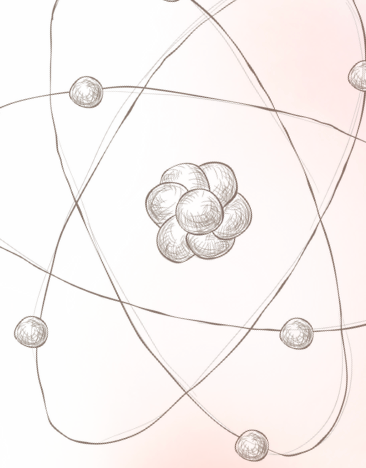
What is Atomic Fission?
Picture the universe as a grand Lego set, except the building blocks are so tiny that you can't see them. Around 2,500 years ago, Indian philosopher-scientist Acharya Kanad described these invisible blocks as paramanu, which are indivisible particles that make up everything in existence.
Acharya Kanada was an Indian philosopher and scientist who developed atomic theory based on the concept of anu, which means atom in Sanskrit. He believed that all matter was made up of tiny, eternal and indestructible particles called atoms, which can combine to form different objects. His atomic theory predates John Dalton's discovery of atoms by approximately 2,500 years.
Acharya Kanad conceptualised the idea of an indivisible particle, which he called parmanu (atom), when he was unable to divide it into any further parts. He proposed that this particle could not be sensed by any human organ or seen by the naked eye. Acharya Kanad also suggested that an inherent urge caused a parmanu to combine with another.
Fast forward to modern physics and we find ourselves talking about atomic fission, the process where the nucleus of an atom splits into smaller parts, releasing an immense amount of energy. Acharya Kanad's description eerily parallels the concept that the tiniest particles could interact, combine and transform; a precursor to the atomic theories we credit to John Dalton and later to the nuclear age.
What is Vajra of Indra Dev?
Now leap 7,000 years back, into the world of the Rig Veda. Here, we meet Indra Dev, king of the Devas, wielding the mighty Vajra—a weapon described as having thunderbolt-like power, capable of unleashing immense energy.
Rig Veda talks about Indra's Vajra:
य: ते मन्यो:शिथिर वज्र शायक सह ओज: पुष्यति विधामनुष्कृ। साहाम दासमायं त्या सुजा सहस्फुतेन सहसा सहस्वती॥
The Sanskrit verse describes the Vajra as an extremely powerful weapon that only the most powerful warrior could handle, with effects so extreme they could alter battles instantly. Modern parallels often draw a comparison between the Vajra and high-energy devices; even likening it to the Tesla coil (invented in 1891), which channels and discharges massive amounts of electrical energy.
In the Vedic imagination, the Vajra was not just a physical weapon but also a symbolic embodiment of concentrated unstoppable force.