When we think of great scientific discoveries like gravity, the speed of light, telescopes etc; our minds usually jump to more recent names: Newton, Roemer, Galileo. Yet long before these breakthroughs entered European texts, ancient Indian scriptures had already talked about them. The Vedas, Puranas and Sutras are not just spiritual guides, they contain profound insights into the natural world.
Let's explore some fascinating examples where Vedic wisdom anticipated modern science by centuries, even millennia.
1. Gravity in the Vaisheshika Sutras
The Vaisheshika Sutras, attributed to the sage Kanada around 600 BCE, mention a concept strikingly similar to gravity. The text uses the word Gurutwa, meaning "that which pulls downwards."
भूआकर्म ह्ससपर्गो गुण।
Translation: Action of body and its members are also from the conjunction with the hand. The above sutra describes that it is due to the contact with the hand, the object remains. The Sutra (5.1.6) describes that objects, when left without support, fall to the ground. This simple observation reflects a deep understanding of natural laws—something that was not formally articulated in Europe until Isaac Newton in the 17th century. Vaisheshika Sutras mention gravity 2,400 years before Isaac Newton.
2. Speed of Light in the Rig Veda
One of the most striking revelations comes from the Rig Veda (1.50.4), where Rishi Sayana (14th century CE) interprets a verse about the Sun's rays 7,000 years ago. His commentary calculates the speed of light as 2,202 yojanas in half a Nimisha.
When converted into modern units, this works out astonishingly close to 2,99,000 km/second—nearly identical to the scientifically proven value of 3,00,000 km/second established by Ole Roemer in 1676.
This shows how ancient seers, without modern instruments, could explore cosmic truths through their heightened intuition.
3. Telescope in Halebidu Temple
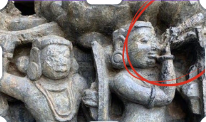
In Karnataka's 12th-century Halebidu temple, sculptures depict figures holding what look remarkably like long optical instruments resembling telescopes.
This predates Galileo's first telescope in 1608 by nearly 500 years. The carvings show that ancient artisans and thinkers had conceptualised magnification devices far earlier than Europe's Renaissance scientists.
4. Pinhole Camera at Virupaksha Temple
At the Virupaksha Temple in Hampi, dating back over 1,400 years, the principle of the pinhole camera was already in practice. A small hole allows sunlight to pass through and project an inverted image of the temple tower onto a surface inside the temple hall. This phenomenon was described in temple architecture centuries before Ibn al-Haytham (11th century) is credited with formalizing the concept in optics. For devotees, this wasn't just science—it was a way to witness the divine play of light and shadow.
5. The Water Cycle in the Vayu Purana
Verses from the Vayu Purana written 2,500 years ago (shloka 51.14, 51.15 and 51.16) describe the evaporation of water by the sun, its condensation in the sky, and the return of rain to earth.
The text clearly states:
"Water evaporated by the sun ascends into the atmosphere, cools, condenses, forms clouds, and returns again as rain — never lost, only transformed."
This was written nearly 2,000 years before Bernard Palissy (1580 CE) in Europe described the same cycle in scientific terms.
These examples remind us that India's scientific heritage is not a myth but a legacy of observation, reasoning, and recording. The Vedic seers may not have had laboratories, but they had disciplined minds, and a profound connection with nature which gave them deep insights about different scientific concepts. By acknowledging these ancient insights, we celebrate a civilization that looked at the stars, rivers, and skies with both reverence and reason.