
By Vaibhav Kalra
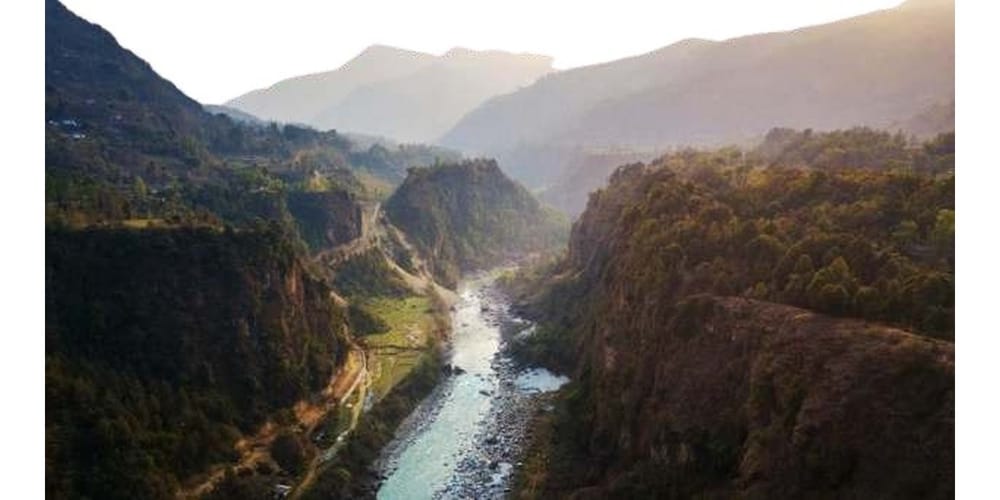
The wind begins before the river comes into view, moving through the Kali Gandaki Valley with a low, ancient voice, as though it has travelled unchanged for millions of years. When the river finally appears—dark, glacial and restless—it becomes clear that this is not merely a geographical feature but a living corridor of time, devotion and Vedic Consciousness. The Kali Gandaki does not simply flow through the Himalayas; it flows through the very idea of existence itself. Deep within the rugged embrace of Nepal, between the towering peaks of Annapurna and Dhaulagiri, the river carves what is widely regarded as the deepest gorge on Earth. Originating in the high-altitude deserts of Mustang, it moves through a stark, wind-sculpted landscape of ochre cliffs and vast, open skies. The air is thin and crisp, carrying the scent of Juniper and the distant chime of temple bells. In this remote terrain, the Earth's ancient memory feels exposed, its layers revealing a story that stretches back over 165 million years.
Embedded within the river's grey silt and glacial currents are the Saligrama stones—smooth, jet-black fossils of ammonites from the primordial Tethys Ocean. When the Indian tectonic plate collided with Eurasia, these marine remnants were thrust upward to form the Himalayas, eventually carried by the river into its present course. While geology identifies them as fossils, Vedic tradition understands them as divine manifestations, forming a rare intersection where science and spirituality converge without contradiction.
In the Vaishnava tradition, the Saligrama is revered as the swarupa or self-manifested form, of Vishnuji, the Preserver of the Creation. These stones require no consecration; they are inherently sacred. Their natural spiral patterns, known as chakras, are seen as imprints of the Sudarshana Chakra, Vishnuji's Cosmic discus. Each variation in shape and marking corresponds to different aspects or incarnations of Vishnuji, transforming every stone into a sacred expression of Cosmic order. What makes this belief remarkable is its seamless alignment with the natural world—divinity revealed not through human Creation but through geological time.
To hold a Saligram is to encounter a profound paradox central to Vedic philosophy. It is an object that predates humanity, that has witnessed the shifting of continents and the birth of mountains, yet it exists intimately within daily acts of worship. It is bathed, adorned and revered in homes and temples, bridging the vastness of deep time with the immediacy of devotion. In this way, the Kali Gandaki becomes a living embodiment of Sanatan Dharm, the eternal order that connects all existence. The journey along the river gradually becomes a pilgrimage. Passing through villages such as Kagbeni and Jomsom, movement slows into mindfulness. Pilgrims walk with quiet attention, searching the riverbed not with urgency but with reverence. Each stone discovered, is received as grace rather than chance. The constant roar of the river becomes a mantra, echoing the Vedic understanding that life is a continuous flow, ever-changing in form yet rooted in an unchanging cosmic reality.
This sacred path leads to Muktinath, the revered "Place of Liberation," situated at an altitude of 3,710 meters. One of the 108 Divya Desams in Vedic tradition, it is a site where the elements converge in powerful symbolism. Within the temple complex, 108 water spouts channel the icy waters of the Kali Gandaki, beneath which pilgrims bathe to cleanse lifetimes of accumulated karma. Nearby, an eternal flame burns, representing the fire element, while the surrounding air, earth, and expansive sky complete the presence of all five elements described in Vedic thought. In the presence of the Kali Gandaki, distinctions dissolve, leaving only the essence of seeking and experience.
Spiritual travel here unfolds differently from modern tourism. It demands stillness, patience and a willingness to move in rhythm with the land. Each step on the rocky trail becomes an act of awareness, each breath a reminder of presence. The landscape, though austere, is profoundly alive, holding within it the echoes of geological upheaval, mythological narrative and living devotion.
As the sun sets behind the Himalayan peaks, casting long shadows across the riverbed, the deeper meaning of the Saligrama reveals itself. These stones are not merely remnants of the past; they are anchors connecting human life to the vast cycles of the universe. They remind us that the divine is not distant, but embedded within the fabric of the natural world, waiting to be recognized. Leaving the Kali Gandaki is not an ending but a continuation. One carries not just memory, but a shift in perception—the awareness of being part of a story that began long before humanity and continues to unfold. This is the essence of spiritual travel: to journey outward into remote landscapes and discover an inward expansion. Along the Kali Gandaki, the sacred is not constructed but revealed, flowing quietly through the heart of the Himalayas and through the timeless depths of existence itself.