
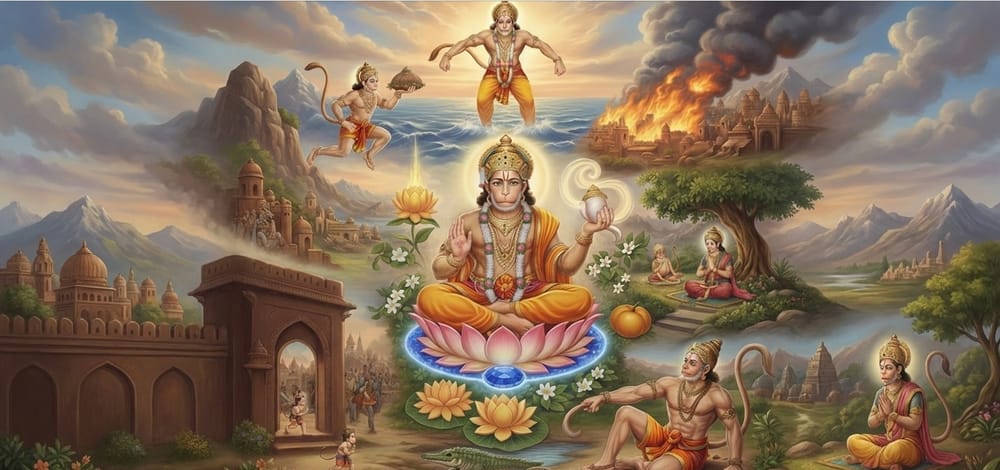
According to scriptures such as Ramayana, puranas and Hanuman Chalisa, Hanumanji is said to possess ashta siddhis (eight divine perfections) through his boundless devotion and yogic discipline and nav nidhis (nine treasures). In Hanuman Chalisa, Tulsidasji writes “Mata Sitaji granted you the boon to bestow the eight siddhis and the nine treasures.”
Anima- The first of the siddhis, Anima is the ability to become minute beyond perception. Hanuman ji displayed this power when he entered Lanka in search of Mata Sita.
In Valmiki's Ramayana, it is described how he shrank himself to the size of a tiny insect to slip past the watchful eyes of Ravana's guards. His mastery of form was not born of pride but of purpose, for he used this power to fulfil Bhagwan Ram's mission of dharma.
Mahima- It is the capacity to expand infinitely. The crossing of the ocean to Lanka is the most celebrated demonstration of this siddhi. When challenged by the ocean itself and celestial beings who sought to test his strength, Hanuman ji grew into a colossal form, filling the sky with his radiance before leaping across the hundred yojanas of sea. In this act, his physical expansion symbolised the spiritual vastness of devotion that transcends all obstacles.
Garima- It is the ability to become immensely heavy and is revealed when Bheem, another son of Vayu, encounters him in the times of Mahabharata. Disguised as an old monkey lying across Bheem's path, Hanuman ji requests Bheem to lift his tail. To Bheem's astonishment, he cannot move it despite his Herculean strength.
This story not only illustrates Hanuman ji's garima siddhi but also teaches humility, reminding even the strongest warrior that spiritual strength surpasses mere physical power.
Laghima- It is the ability of becoming light as air. Hanuman ji's effortless leaps across mountains and skies reflect this siddhi. His flight to the Himalayas in search of the Sanjivani herb is a dramatic testimony. With his body lighter than the wind, he soared across the earth and returned carrying an entire mountain when he could not identify the herb. Here, mystical lightness was matched with an unwavering will to save Lakshman's life.
Prapti- It is the ability to obtain anything and is seen when Hanuman ji reaches Lanka and directly beholds Sitaji in Ashok van. No fortress, demon or barrier could stop him; what he desired for the sake of dharma manifested. In a deeper sense, this power signifies his capacity to attain divine grace itself, for Hanuman ji's greatest possession was always Bhagwan Ram's name in his heart.
Prakarma- It is the fulfilment of desires and is expressed in the many instances where Hanuman ji's inner resolve translated into reality. When he vowed to burn Lanka after being captured, fire could not harm him. Instead, his burning tail consumed the city, a cosmic expression of his will aligning with Bhagwan Ramji's justice.
Isitva and Vasitva The siddhis of lordship and control and ability to influence others are subtly portrayed. Hanuman was never a ruler in the worldly sense, yet elements themselves obeyed his command. The winds bore him aloft, fire became his aid and even Yama, the god of death, could not touch him, for he was blessed with immortality.
The nine nidhis of Hanuman, as described in the Hanuman Chalisa, are treasures or types of wealth granted to him by Mata Sitaji. These include:
● Mahapadma: Great lotus flower (symbolising immense wealth)
● Padma: Lotus flower (symbolising purity)
● Shankha: Conch shell (symbolising victory)
● Makara: Crocodile (symbolising protection)
● Kachchhapa: Tortoise (symbolising longevity)
● Mukunda: A kind of fruit (symbolising prosperity)
● Kunda: Jasmine (symbolising purity and beauty)
● Nila: Sapphire (symbolising spiritual wisdom)
● Kharva: Dwarf (symbolising humility)
In the Bhavishya Purana, it is said that Hanuman ji would live as chiranjivi, the eternal server of Bhagwan Ram until the end of this cosmic cycle. His dominion was not for domination but for protection of dharma.
What distinguishes Hanuman ji from other bearers of mystical powers is the spirit in which he wielded them. In the Ramcharitmanas, he declares, “Jıv̄ ana hetu prabhu charaṇan lāgı,̄ kāya sudhā kari sevaka bhāgı"̄ “The purpose of my life is to be attached to the feet of my Prabhu; my body is sanctified only by service.” His siddhis were never for self-glorification but only as instruments of devotion to Hari karya. Even the nava nidhis, the nine treasures of Kubera over which he was granted mastery, were subordinated to his role as Bhagwan Ram's servant.