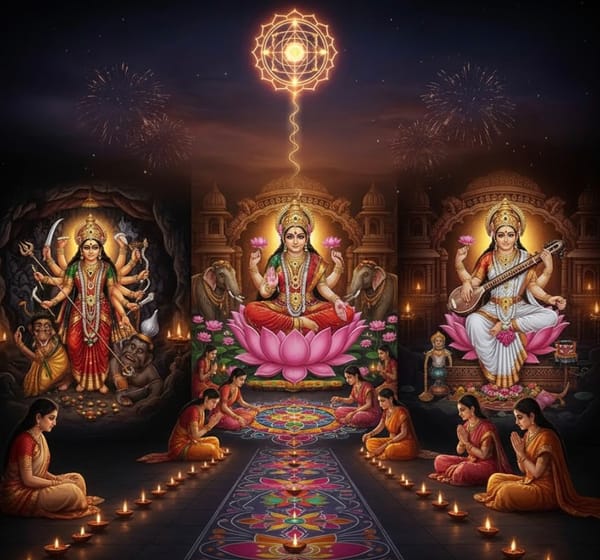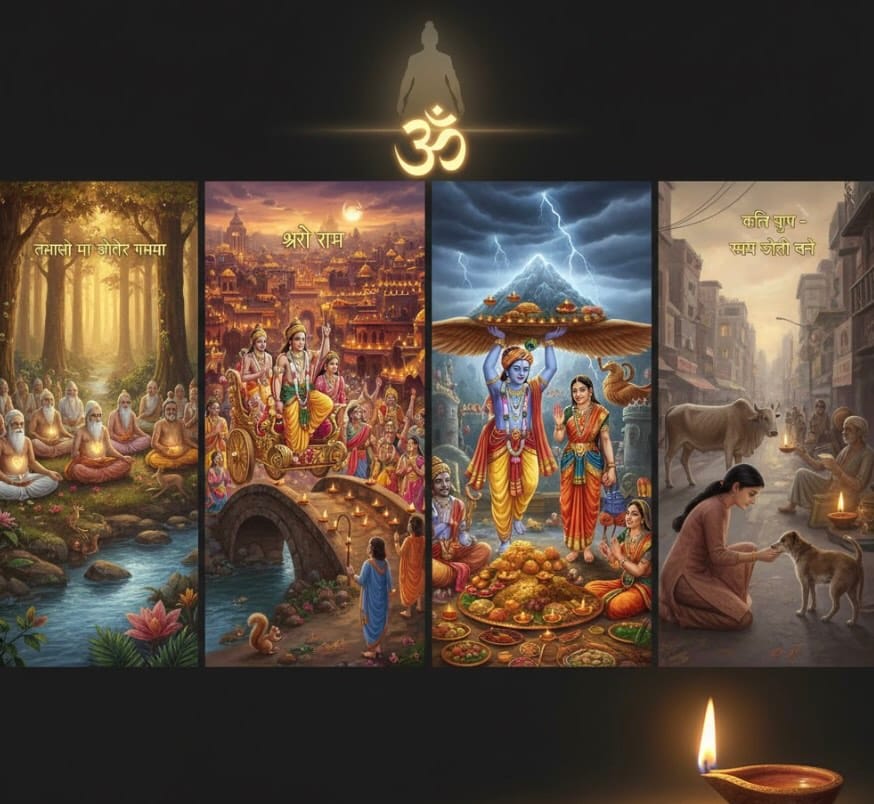
The Festival of Lights is not merely a seasonal celebration or a symbolic tradition. It is a divine rhythm echoing across the four yugas - Satya, Treta, Dvapar and Kali Yug. Its essence is the ever-relevant truth that light, as an emanation of Shri Hari's grace, always triumphs over darkness. To understand Diwali through the lens of Vedic knowledge is to trace the divine interventions of Shri Hari as he upholds dharma across cosmic time.
Satya Yug
In Satya Yug, the age of perfect righteousness, all beings were inwardly attuned to dharma. Dharma was at its peak; humanity lived in harmony with nature and divine beings often walked among mortals. Shri Hari's presence was not obscured by ego or materialism. Human life in this era was grounded in satya and samadhi.
While the outward festival of diwali was not required, the inner lamp of divine knowledge was always lit in the hearts of realised beings.
The Brihadaranyaka Upanishad captures the central truth of this Yug:
tamaso ma jyotir gamaya (Lead me from darkness to light)
This is the seed of Diwali, not as ritual but as constant spiritual awareness. In this age, Diwali was not a festival in the modern sense, it was a cosmic observance of inner light.
Treta Yug
In this yug, Bhagwan Vishnu incarnated as Shri Ram, the embodiment of dharma and the maryada purushottama, the perfect upholder of righteousness. His descent was a divine mission for the spiritual evolution of all beings including the vanar sena, Jatayu, the devoted squirrel, humans and all creatures who assisted in Hari Karya. Shri Hari gave opportunity to every soul to evolve through service and devotion. After defeating Ravana, Shri Ram's return to Ayodhya is vividly described in the Valmiki Ramayan, where the joyous citizens celebrated his homecoming by lighting an ocean of oil lamps to symbolise the restoration of cosmic order.
The Skanda Purana further elaborates on this grand celebration of lamps as a sacred tradition to honour the triumph of divine light over darkness. Sages such as Vishwamitra, Vashistha and Agastya played vital roles as spiritual guides throughout Shri Ram's journey, exemplifying divine cooperation in restoring dharma.
The story of the squirrel assisting in building the bridge to Sri Lanka highlights how even the smallest beings were given roles in this cosmic mission, alongside the mighty Hanumanji whose boundless devotion, strength and wisdom were instrumental in the search for Mata Sita and the eventual victory over Ravana. As the divine play continued through the ages, the cosmic narrative evolved with new avatars and fresh expressions of dharma.
Dvapar Yuga
In Dvapar Yug, the luminous festival of Diwali took on new dimensions through the divine acts of Shri Krishna, the avatar of Shri Hari. As the world tilted further from dharma, Shri Krishna incarnated not only to guide the Pandavas and share the wisdom through the Bhagavad Gita but also to directly confront rising waves of adharma.
The celebrations involve Govardhan Puja, which celebrates Shri Krishna lifting the sacred Govardhan mountain to shelter the people of Vrindavan from Lord Indra's wrathful rains. By rejecting the pride of celestial rituals and instead honouring nature and devotion, Shri Krishna redefined worship itself, teaching that Bhakti, not fear, is the path to Divine grace. Villagers celebrated by offering food (annkoot) to Govardhan Mountain and lighting lamps in gratitude for Shri Krishna's protection.
Diwali also acknowledges the slaying of Narakasur, a powerful demon who had captured and imprisoned 16,000 noble women and oppressed the Earth. On Naraka Chaturdashi, Shri Krishna accompanied by Satyabhama, vanquished Narakasur, freeing the captives and symbolising the soul's liberation from bondage. The people rejoiced by lighting lamps, representing the victory of divine light over the darkness of ego, oppression and ignorance.
Thus, Diwali has become a multi-day celebration, Dhanteras for divine health (Dhanvantari), Narak Chaturdashi, amavasya/Lakshmi Puja, and Govardhan Puja. Each day reflects the deeper truths of Shri Krishna's life: that divine love protects, liberates, heals and uplifts, even in the times of crisis. Diwali, therefore, was not merely a festival of lights, but a reaffirmation that in every age, Shri Hari manifests to guide the soul from darkness to light, from fear to faith and from mortality to the eternal.
Kali Yug
But today in Kali Yug is the age of darkness, Diwali is more than a festival of lamps. It is a divine mirror asking us, if Shri Hari were here, standing in our place, what would He do? Would he simply light a diya, ring a bell and walk away? Or would he stop to feed the hungry dog outside the temple and offer food and treatment to an injured and hungry bull in the street, just as He did in Dwapar and Treta Yugs? Hanumanji crossed oceans not for power, but out of selfless service. Today, it is our turn.
This Diwali do not just light a lamp but rather be the light. Carry bananas in your bag for a hungry animal. Keep water outside your home. Feed someone who cannot ask. Be the voice if injustice is done against any voiceless. Stand up for Dharma. These small acts are not separate from worship; these are positive karmas that would go towards the Hari Karya.