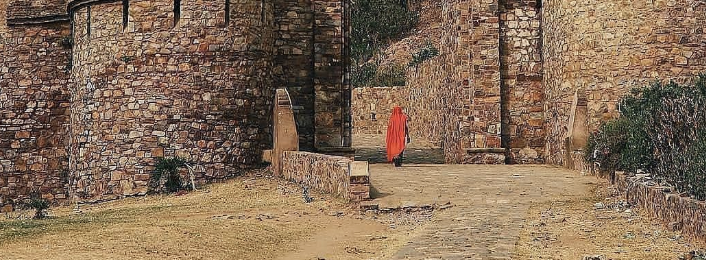
Nestled on the edge of the Sariska Tiger Reserve in Alwar district lies a fort unlike any other—Bhangarh Fort; notorious as the most haunted fort of India. Its broken ramparts and silent courtyards do not just speak of medieval kings and queens; they echo with whispers of curses and ghostly apparitions. In fact, the Archaeological Survey of India (ASI) has put up boards warning visitors not to enter after sunset.
THE RISE OF BHANGARH
Bhangarh was built in the late 16th Century by Raja Bhagwant Das, ruler of Amber, for his son Madhav Singh I. At its peak, it was a thriving township, filled with palaces, bazaars and temples. The architecture reflected a blend of Rajput strength and Mughal refinement, showcasing prosperity and ambition. But prosperity did not last long. By the 18th century, Bhangarh had been abandoned, its once-bustling streets left to crumble. While famine and invasions are often cited as causes, folklore insists the city's fate was sealed by a curse.
The temples are among the most remarkable survivors, especially the Gopinath Temple, with its towering spire and delicate stone carvings. Shrines of both Bhagwan Shiv and Bhagwan Vishnu suggest that spiritual life was central to the town.
THE CURSE OF THE TANTRIK
According to legend, Princess Ratnavati, who was famous for her beauty, was pursued by a sorcerer skilled in black magic. Determined to win her, he cast a spell on oil meant for her, hoping to enslave her heart. Realising his plan, Ratnavati flung the oil away, where it struck a boulder that rolled and crushed the sorcerer. As he died, he cursed the fort: "Bhangarh will perish and no one shall live here in peace." Soon after, famine and battles swept through, the town fell to ruin.
WHISPERS IN THE DARK
Locals claim that after dusk, strange sounds drift across the ruins—women crying, anklets jingling, faint strains of music. Some visitors report a sudden chill despite the desert heat or the unsettling sense of being watched.
Stories abound of thrill-seekers who tried to spend the night inside. Many returned shaken, claiming to have heard voices, seen shadowy figures or felt an oppressive dread that forced them to leave. A few never returned at all, further fuelling the fort's ominous reputation.
Adding to the unease is the emptiness of the surrounding area. No houses are built close to the fort; villagers say those who tried to settle nearby faced misfortune. Unlike other forts in Rajasthan that have been repurposed into hotels or tourist hubs, Bhangarh remains abandoned, shunned by permanent habitation.